Keypoints
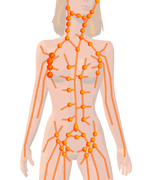
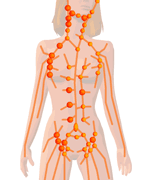
Principles of staging non-Hodgkin's lymphoma Deciding the stage of a non-Hodgkin's lymphoma depends on where it is in the body, how many groups of lymph nodes are affected, and whether it has spread to other parts of the body. This involves a number of staging tests to find out the extent of the disease. Although there are several systems used to stage non-Hodgkin's lymphoma, including the Ann Arbor system, the most common staging system uses four stages, numbered in Roman numerals I-IV. In its simplest form, stages I and II are often grouped together as early-stage disease, while stages III and IV are grouped together as advanced-stage disease.
In addition, the letter 'A' or 'B' is sometimes added to the stage number, depending on whether or not any of three specific symptoms is present:
'A' means that none of these symptoms is present, while 'B' means that at least one has been seen. So, for example, a person with stage IIB non-Hodgkin's lymphoma has lymphoma in two or more groups of lymph nodes, all of which are either in the chest or in the abdomen, and has one or more of the three symptoms above. A person with stage IVA non-Hodgkin's lymphoma has lymphoma that has spread outside the lymph nodes and has none of these three symptoms. |
|
|
 |
 |
What is non-Hodgkin's lymphoma?